The pantheon · The Celestial Bureaucracy
Caishen
財神 · Caishen (Wade-Giles: Ts'ai-shen)
Daoist
The office of wealth, held by several gods
Not one god but an office of wealth filled by several figures — the martial Zhao Gongming, the civil wealth gods, and in many temples Guan Yu — honoured especially at the lunar new year.
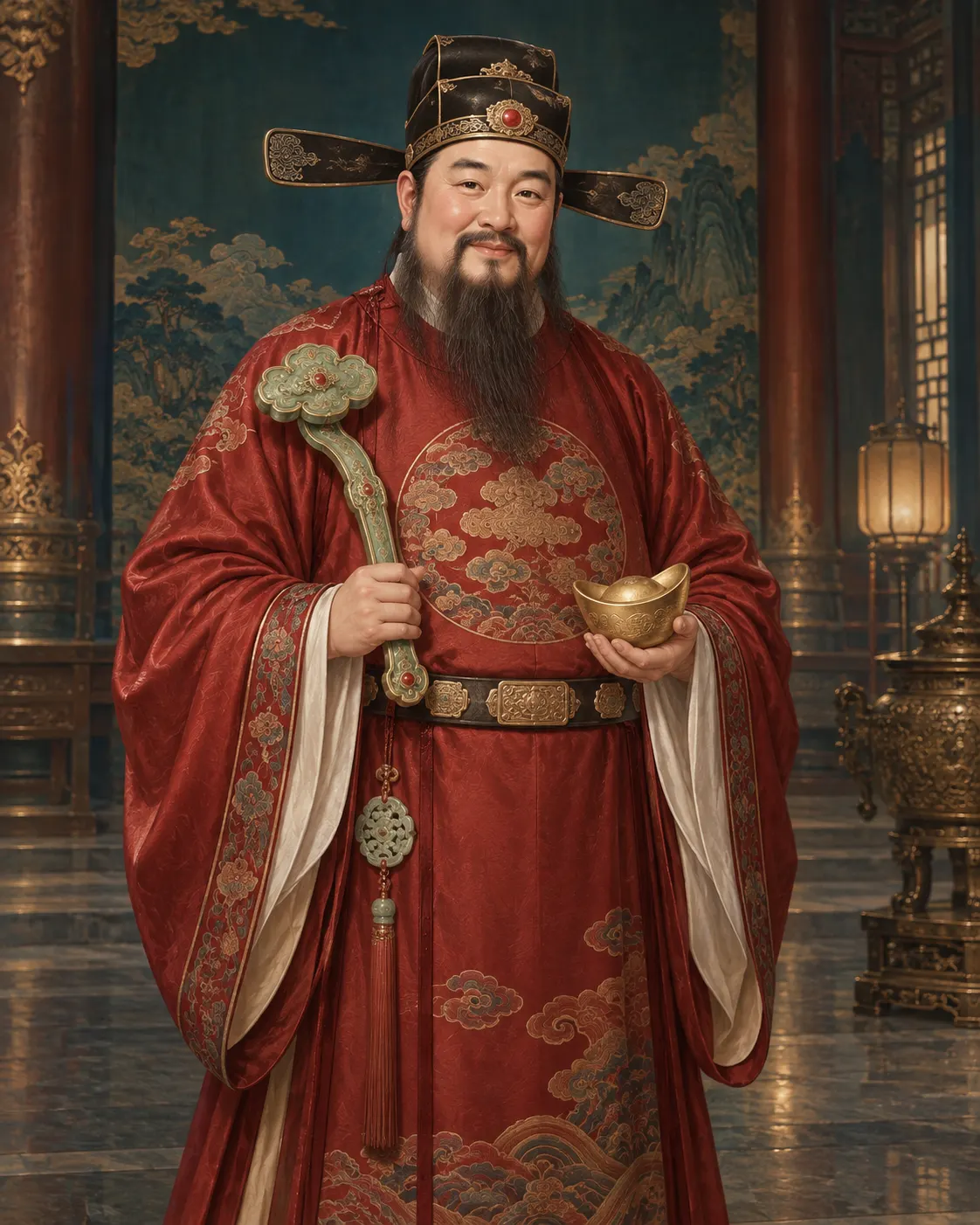
- Portfolio
- Wealth and commerce · Fair dealing · The account of gains and losses
- Observance
- Welcomed on the fifth day of the first lunar month, when businesses reopen after the new-year holiday.
How to recognise them
Because the office is filled by several gods, the image varies. The martial Zhao Gongming rides a black tiger and carries an iron whip; the civil wealth gods wear the red robes of an official and hold a ruyi or an ingot. A gold ingot (yuanbao) is the sign common to nearly all of them.
Caishen (Ts'ai-shen, 財神) is less a single god than an office — the God of Wealth — that different figures have filled in different times and places. This is the first thing to understand about him: the question 'who is Caishen' has several correct answers at once, depending on the region and the temple.
The best known is Zhao Gongming, a martial figure from the novel Fengshen yanyi who rides a black tiger and wields an iron whip; after his death in the story he is enfeoffed as the marshal set over wealth and its distribution. Alongside him stand the civil wealth gods, and in many temples Guan Yu, the loyal general, is honoured in the very same role.
He is welcomed on the fifth day of the first lunar month, when shops reopen after the new year and firecrackers greet his return to the streets. What the custom expresses is a wish for an honest and prosperous year of trade — a hope entrusted, not a bargain struck.
That distinction matters here. The tradition associates Caishen with prosperity and fair dealing; it does not promise an outcome, and neither do we. His lamp on this site is offered as a focus for intention, in the same spirit the custom itself has always carried.
Keep a lamp
Caishen Lamp
Kept for ventures and livelihoods, after Caishen, the keeper of prosperity lore.
Open the hallNearby

Written from
- The Sinister Way: The Divine and the Demonic in Chinese Religious Culture — Richard von Glahn, University of California Press, 2004
- Fengshen yanyi (The Investiture of the Gods)
These pages are written from published scholarship and primary texts, and each figure lists what it was written from. Where sources disagree, we say so rather than picking one and presenting it as settled. This site is not affiliated with, endorsed by, or speaking for any temple, monastery, lineage, or religious organisation. Nothing here is a substitute for a tradition’s own teachers. We describe what practitioners have believed and done. Describing a belief is not asserting it is true.