The pantheon · The Six Realms of Rebirth
Guanyin
觀音 · Guanyin (Wade-Giles: Kuan Yin)
Buddhist
Bodhisattva of Compassion
The most widely venerated bodhisattva in East Asia, invoked as the one who hears the cries of the world and answers them with mercy rather than judgement.
- Portfolio
- compassion · mercy · protection · safe childbirth · relief from suffering
- Observance
- Guanyin's feast days follow the lunar calendar, with her birthday observed on the nineteenth day of the second lunar month and further days marking her enlightenment and her renunciation.
How to recognise them
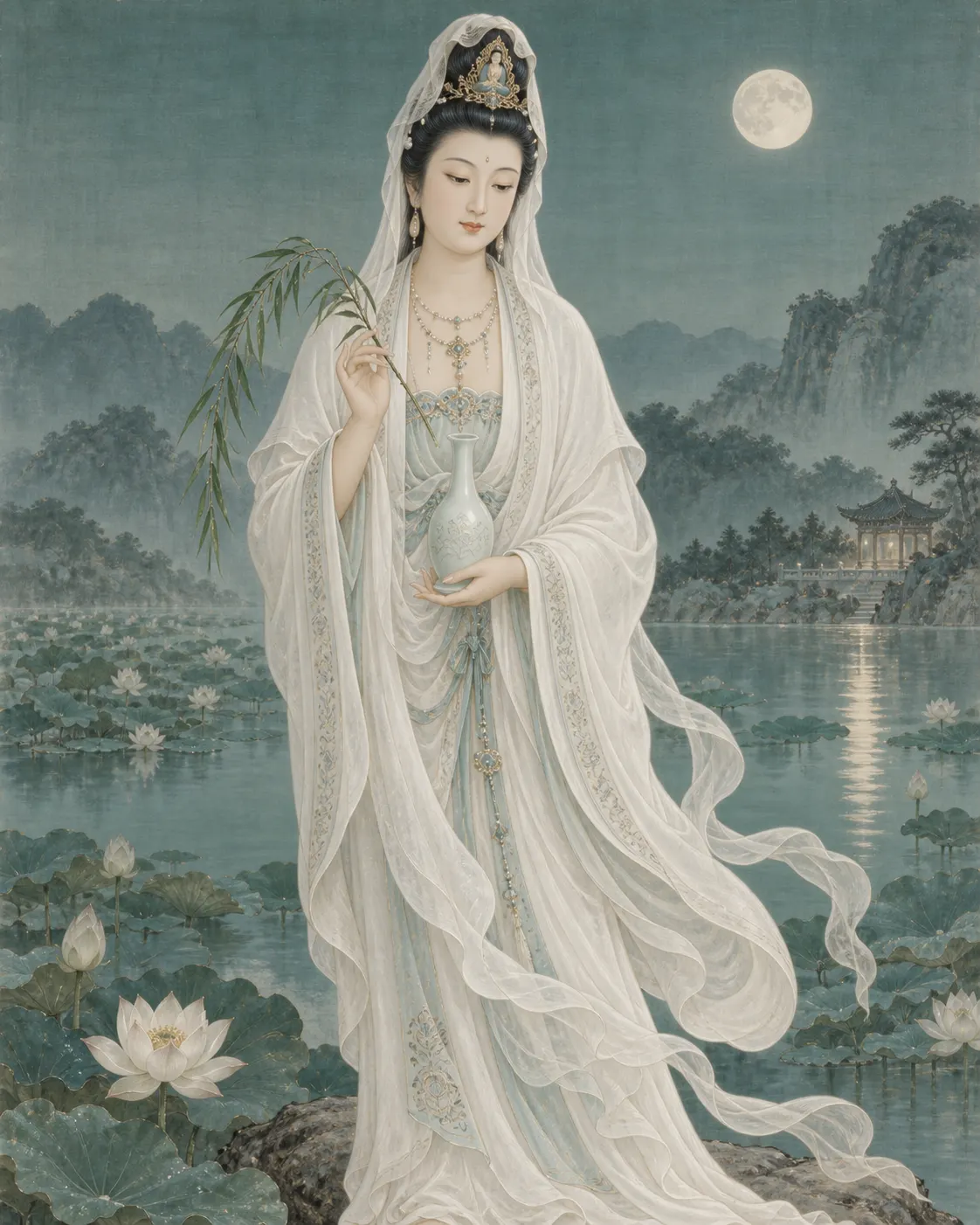
Usually shown in flowing white robes holding a slender vase of pure water and a willow branch, sprinkling the nectar of compassion. A small figure of Amitabha Buddha often sits in the headdress. Popular forms include the thousand-armed, thousand-eyed image, each hand reaching toward a different being in need.
Guanyin (Kuan Yin, 觀音) is the Chinese name for Avalokiteshvara, the bodhisattva of compassion who came to China with Indian Buddhism. The name translates the Sanskrit almost literally: the one who perceives — guan — the sounds — yin — of a suffering world. In the earliest sources the figure is male, and Tang-dynasty images still depict a slender, sometimes moustached male bodhisattva.
Between roughly the tenth and fourteenth centuries, Guanyin was gradually reimagined in China as female. Scholars such as Chün-fang Yü trace this to indigenous legends, the rise of devotional cults, and the appeal of a maternal figure of mercy. By the Ming dynasty the female Guanyin was the dominant form, and today most East Asian devotees picture a woman in white. The transformation is one of the most remarkable examples of a deity changing gender within a living tradition.
The best-known Chinese legend gives Guanyin a human back-story as Miaoshan, a princess who refused marriage, endured her father's cruelty, and finally sacrificed her own eyes and hands to heal him. Devotees read the story as an account of compassion carried to its limit. As with every account on this site, we are describing what the tradition holds, not asserting it as historical fact.
Guanyin belongs to Buddhism, not Daoism — a distinction English-language sources routinely blur. She is a bodhisattva: an enlightened being who postpones final nirvana to help others, a specifically Buddhist idea with no equivalent in the Daoist pantheon. Chinese popular religion later welcomed her alongside Daoist and folk deities on the same family altar, but that shared worship reflects how Chinese people practise, not a merging of the two traditions' doctrines.
Keep a lamp
Guanyin Lamp
Kept for steadiness and care, after Guanyin, the bodhisattva who hears.
Open the hallNearby
Written from
- Kuan-yin: The Chinese Transformation of Avalokiteśvara — Chün-fang Yü, 2001
- The Lotus Sutra, "Universal Gateway of Bodhisattva Avalokiteśvara" (Chapter 25)
These pages are written from published scholarship and primary texts, and each figure lists what it was written from. Where sources disagree, we say so rather than picking one and presenting it as settled. This site is not affiliated with, endorsed by, or speaking for any temple, monastery, lineage, or religious organisation. Nothing here is a substitute for a tradition’s own teachers. We describe what practitioners have believed and done. Describing a belief is not asserting it is true.